
You may want enough breathing room to finish a cup of coffee, prepare food or sit beside your child with a book. That is a reasonable goal. What an activity list cannot honestly promise is an uninterrupted hour from a child who needs company, help or a different setup today.
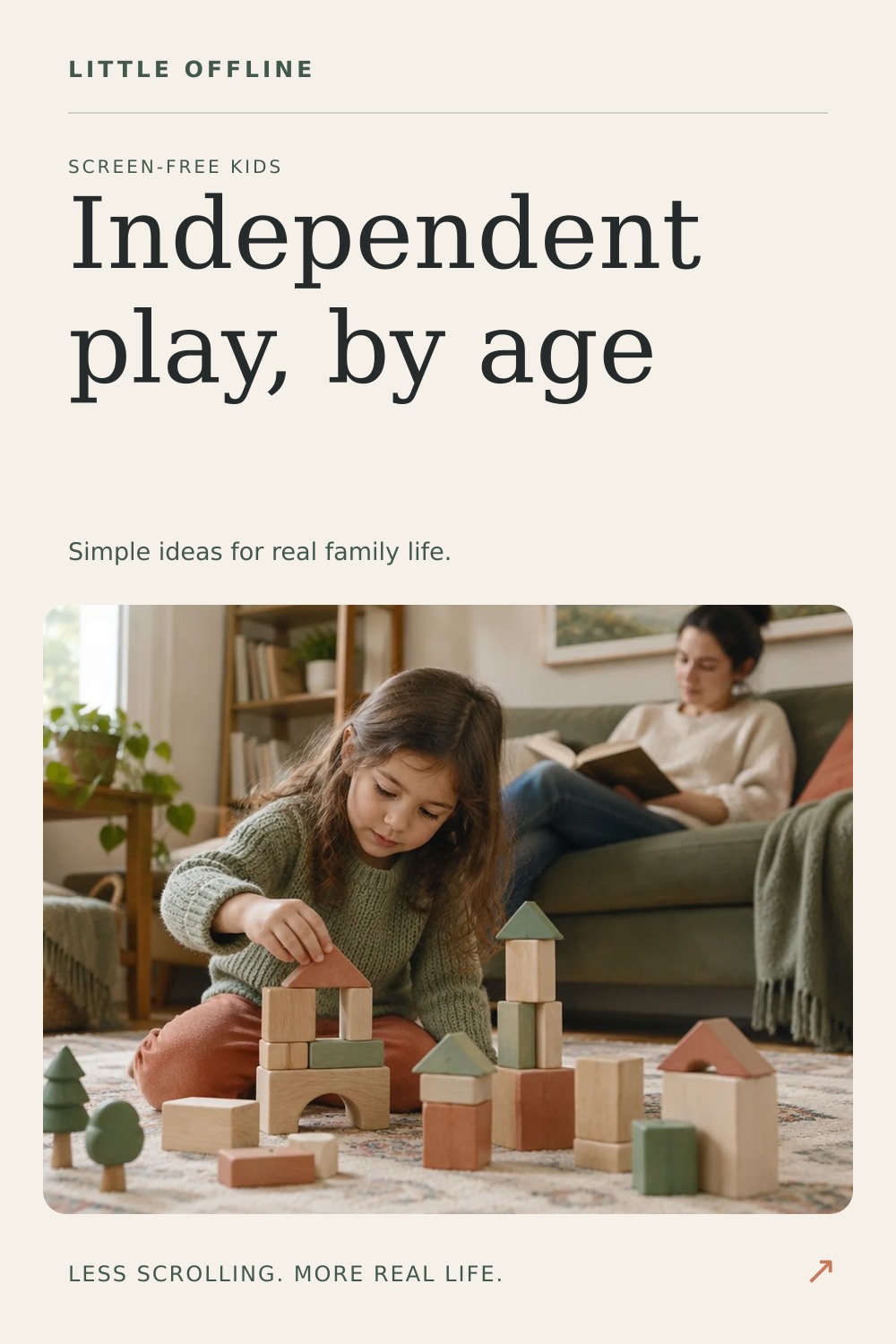
Think of independent play as ownership of the activity, not absence of an adult. A three-year-old sorting socks next to you and a ten-year-old revising a comic at the table can both be choosing what happens in their play. The level of supervision remains an adult decision.
A practical starting setup by age
| Age | Offer | Your first job | A reasonable adjustment |
|---|---|---|---|
| 3–4 | A familiar book, large blocks or two-pair sorting | Show one action and stay close | Use fewer pieces and join again when needed |
| 5–6 | A paper scene, simple pattern or pretend menu | Make the materials usable and explain the boundary | Offer a choice of two clear tasks |
| 7–8 | A comic, paper puzzle or map | Help define a small first version | Let the child decide the details |
| 9–10 | A design project, journal or invented game | Agree on tools, space and a stopping point | Offer feedback when invited |
12 activities to choose from
Time and age labels are planning suggestions. Use the adaptations and provide the adult help your child needs.
1. Sock match detectives
What you need: Clean socks and a laundry basket. Cost: Use what you have.
Tip six socks onto the floor and ask your child to reunite the pairs. Make a small parking space for each finished pair instead of insisting on perfectly folded bundles. Once the obvious matches are done, choose a mystery sock and describe its clues without naming its color. Stop while it still feels like a game; the whole laundry pile can wait.
Make it fit: For older kids, sort by owner and fold pairs. For younger kids, begin with two very different pairs.
Adult help: Adult nearby.
2. The one-box neighborhood
What you need: An empty cereal box, paper and crayons. Cost: Use what you have.
Open a clean box flat and draw a road across the inside. Add one place your family uses, such as a library, grocery store or bus stop. Your child decides what belongs next door and moves a finger along the route. Let the neighborhood change as the story changes; a convincing map is less useful than a place they want to return to.
Make it fit: Offer one building to a younger child. Older kids can add addresses, a legend and delivery routes.
Adult help: Adult nearby.
3. Draw the missing half
What you need: Paper and crayons. Cost: Use what you have.
Fold a sheet in half and draw one side of an imaginary creature, a house or a leaf. Unfold it and invite your child to finish the other side. Matching is optional: a tiny wing beside a huge wing can become the beginning of a story. Swap roles after the first picture so the child gets to set the challenge.
Make it fit: Younger kids can add marks anywhere. Older kids can try symmetry or deliberately invent an asymmetrical creature.
Adult help: Adult nearby.

4. Book picture expedition
What you need: A picture book you already own. Cost: Use what you have.
Open a familiar book and ignore the printed story for one round. Look for something tiny, someone who might be surprised and a place you would like to visit. Give your child time to explain what they see instead of turning it into a right-answer quiz. On the next page, let them choose the question.
Make it fit: Nonreaders can point. Confident readers can find a sentence that supports their interpretation.
Adult help: Adult nearby.
5. Paper cup architecture
What you need: Large paper cups or lightweight plastic tumblers. Cost: Use what you have.
Put a small set of empty cups on the table and build a structure with a wide base. See whether a bridge or doorway can remain standing. Keep towers below face height and use lightweight materials. When the cups fall, ask which piece you would change rather than treating the collapse as failure. Nest the cups together at the end.
Make it fit: Younger kids can make a row and stack two. Older kids can work within a six-cup limit.
Adult help: Adult nearby.
6. Make a comic in four boxes
What you need: Paper and pencil. Cost: Use what you have.
Fold paper into four panels. In the first, introduce a character who wants something; in the second, add a problem; in the third, try a solution; in the fourth, show what happens. Stick figures and speech bubbles are enough. If writing slows the fun, take dictation for your child while they draw the action.
Make it fit: Younger kids can narrate one panel. Older kids can make a wordless comic another person can understand.
Adult help: Adult nearby.

7. The pattern parade
What you need: Large blocks or drawn shapes. Cost: Use what you have.
Arrange three large blocks in a repeating pattern and ask what might come next. Your child can follow your rule or invent another and explain it. If physical pieces cause frustration, draw the pattern instead. Keep small construction pieces away from younger siblings and children who mouth objects, even when an older child is doing the activity.
Make it fit: Begin with two alternating colors. Older kids can create a pattern with more than one changing feature.
Adult help: Adult nearby.
8. Design a pet for a planet
What you need: Paper and crayons. Cost: Use what you have.
Invent a planet with one unusual feature, such as permanent rain or very tall trees. Draw an animal that could feel at home there. Ask where it sleeps, what it carries and how it greets a friend. There is no need to make the design scientifically correct; make the imagined needs and choices clear enough for someone else to follow.
Make it fit: Younger kids can choose one feature. Older kids can label adaptations and sketch a habitat.
Adult help: Adult nearby.
9. Map the room from above
What you need: Paper and pencil. Cost: Use what you have.
Imagine floating safely above the room like a camera and draw where the door, window and largest furniture would appear. Choose one familiar route and trace it with a finger. The map does not need accurate scale. Keep this as a drawing exercise; no one needs to climb to see the room from above or move heavy furniture.
Make it fit: Younger kids can place a drawn bed and door. Older kids can add a key and estimate distances.
Adult help: Adult nearby.

10. The color-family challenge
What you need: Crayons and paper. Cost: Use what you have.
Choose one crayon and fill a small rectangle with as many different marks as possible: dots, spirals, lines and broad shading. Make a second rectangle in another color, then decide what the marks remind you of. Limiting the supplies removes a choice without requiring your child to make a perfect picture or stay inside a complex design.
Make it fit: Younger kids can use large open space. Older kids can draw a whole scene using one color.
Adult help: Adult nearby.
11. The one-page treasure map
What you need: Paper and pencil. Cost: Use what you have.
Draw a pretend island with three landmarks and a starting point. Give a character a route using directions such as past the tree and around the pond. Let your child choose what the treasure is and why someone hid it. Playing entirely on paper works when the room is small or you do not want a real hunt to scatter belongings.
Make it fit: Younger kids can follow a finger path. Older kids can add a key, compass directions and decoy routes.
Adult help: Adult nearby.
12. Make a tiny book
What you need: One folded sheet of paper and crayons. Cost: Use what you have.
Fold a sheet into four panels and use each panel as a page. Put a title on the front, two moments inside and a final image on the back. The book can tell a story, show favorite things or explain an invented machine. An adult can write dictated words; a readable drawing-only book is equally complete.
Make it fit: Younger kids can fill two panels. Older kids can add a contents page in a larger version.
Adult help: Adult nearby.
Start together, then become less central
Spend a brief moment beginning the activity with your child. Draw the first road or match the first pair, then let them choose what comes next. Say what you are doing nearby rather than disappearing without explanation. If they need you again, help with the specific stuck point and see whether they want to continue.
Avoid adding a new challenge every time the child settles. Adult enthusiasm can accidentally take ownership back. Repeating the same story or sorting the same objects may be exactly what makes the activity easy to sustain.
When the plan does not work
Check the setup before judging motivation. Are the materials hard to use? Is the project too open-ended? Is the child hungry, tired or seeking time with you? Reduce the task, offer connection or stop. A difficult afternoon is not evidence that your child lacks imagination.
For work calls, cooking with heat or other tasks that prevent adequate supervision, arrange the care the situation requires. Labeling an activity independent does not make it safe to leave a child unattended.
Keep the supplies simple
Use the materials listed with each activity first. If something is missing, our activity supply collection explains what different items are useful for and what to check before buying.
Questions parents ask
Should I keep introducing new toys?
Not necessarily. Familiar materials reduce the need for instructions. Change a story prompt or the number of pieces before buying something new.
What if my child keeps asking me to play?
Offer a brief shared beginning and a clear nearby role for yourself. If they still need company, adapt the plan rather than treating the request as failure.
Save a little inspiration
Keep this idea for later.
Save the guide to your family activities board.
Save to Pinterest

