
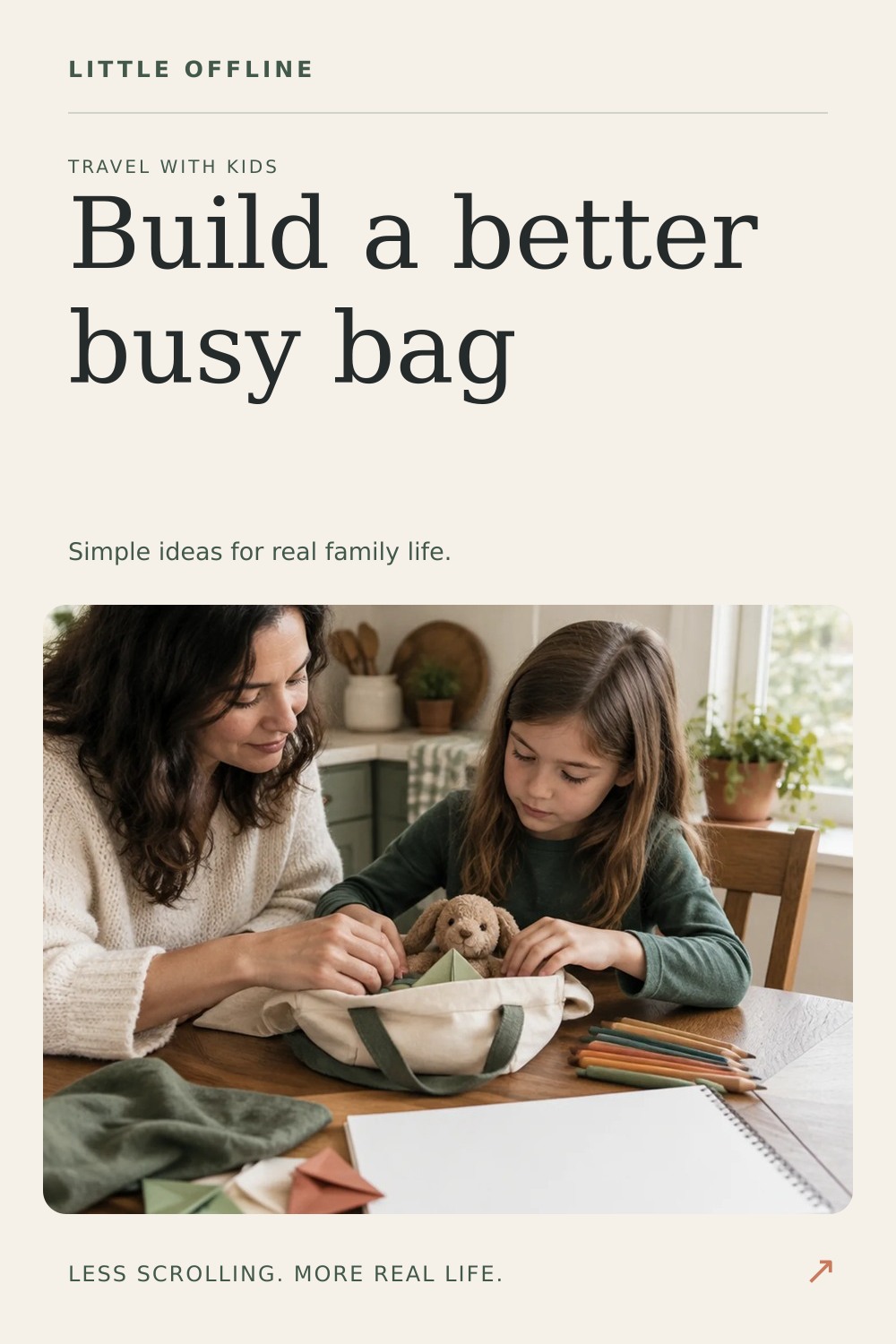
A busy bag is useful when it reduces decisions. If opening it releases twelve tiny toys and three unfinished craft kits, the bag has become another job. Start with a small container and make every item explain its purpose.
You can build a bag from things you already own. A notebook, a book and a few large paper cards may be enough. The goal is a portable menu for a particular child and journey, not a photogenic collection or a promise that the child will stay busy for hours.
Step 1: choose the container before the contents
Use a pouch or small bag that closes securely and is easy for the responsible adult to manage. Check zippers, cords and detachable parts for suitability. A small container creates a useful limit: if an activity cannot fit without being dismantled into dozens of pieces, it may belong at the destination.
Avoid attaching the bag to a child restraint or seat hardware unless the relevant manufacturer explicitly allows the arrangement. Keep storage separate from restraint function.
6 activities to choose from
Time and age labels are planning suggestions. Use the adaptations and provide the adult help your child needs.
1. Reusable water-reveal page
What you need: An age-labeled water-reveal book and its pen. Cost: Use what you have.
An adult fills the pen according to the product instructions before the activity starts. Offer one page at a time and keep the small amount of water contained. Use only where comfortable and permitted; put the book away if looking down causes discomfort. The pages need drying time before the same picture can be revealed again.
Make it fit: For younger kids, model a few broad strokes. Older kids can turn the revealed scene into a story.
Adult help: Adult passenger helps; driver stays focused.

2. Large sticker scene
What you need: Large stickers, backing sheet and a notebook. Cost: Use what you have.
Keep the stickers on their original backing and place them only on the notebook page. Give a simple scene prompt, such as a picnic for imaginary animals, or let the child choose. Keep loose backing paper in the same pouch. Avoid small stickers for children who mouth objects and never stick them to seats or tray tables.
Make it fit: Younger kids may need peeling help. Older kids can make a labeled scene or comic.
Adult help: Adult passenger helps; driver stays focused.
3. The pocket sketchbook
What you need: A small notebook and age-appropriate drawing tool. Cost: Use what you have.
Choose one drawing prompt before handing over the notebook: invent a vehicle, draw the next stop or make a comic about a sandwich. Use a soft, manageable tool and follow transport rules. Keep the kit small so cleanup is a single pouch. If looking down is uncomfortable, switch to a spoken game.
Make it fit: Younger kids can make marks. Older kids can draw a four-panel travel comic.
Adult help: Adult passenger helps; driver stays focused.

4. The storybook retell
What you need: A familiar book or memory. Cost: Use what you have.
Invite your child to retell a book they know, using the pictures or their memory. Ask one open question about a character rather than correcting every detail. A passenger can take over when the child wants to listen. Keep books light and manageable, and put them away if the journey makes close-up looking uncomfortable.
Make it fit: Younger kids can describe one page. Older kids can tell the story from another character’s view.
Adult help: Adult passenger helps; driver stays focused.

5. The reusable drawing board
What you need: An age-appropriate non-electronic drawing board. Cost: Use what you have.
Offer a mechanical drawing board whose parts are suitable for your child. Demonstrate its erase action and suggest one simple prompt. Check for loose components and avoid cords that could tangle. A basic paper notebook is a perfectly workable substitute; choose a board only if repeated erasing is something your child enjoys.
Make it fit: Younger kids can explore marks. Older kids can play draw-and-guess.
Adult help: Adult passenger helps; driver stays focused.
6. The story-in-an-envelope kit
What you need: An envelope with a few large drawings. Cost: Use what you have.
Draw a character, place and ordinary object on separate large paper cards. Pull one of each and make a brief story that uses all three. Return the cards to the envelope between rounds so nothing gets scattered. A child can draw new cards at the destination and reuse the same kit on the return trip.
Make it fit: Younger kids can choose two cards. Older kids can add a problem card.
Adult help: Adult passenger helps; driver stays focused.
Step 2: choose four jobs for the bag
Give the bag a looking option, a making option, a familiar quiet option and a spoken-game reminder. These are functions, not four required purchases. A single notebook can cover drawing and a story game; a favorite book can cover looking and reading together.
For younger children, choose activities you can demonstrate quickly and use with the passenger help available. Older children can choose their own contents within the agreed limit, then show how they will pack everything away.
A simple busy-bag recipe
| Slot | Use what you have | Check before packing |
|---|---|---|
| Look | A lightweight familiar book | Can the child handle it comfortably? |
| Make | Notebook and suitable drawing tool | Will the materials stay contained? |
| Repeat | A known reusable activity | Does it need filling, drying or resetting? |
| Talk | A card with three spoken games | Can someone other than the driver lead? |
Step 3: test the first five minutes
Open the bag at home and let the child choose an item. Watch how much help it takes to start, whether pieces scatter and how easily it returns to the bag. This simple rehearsal reveals more than a product’s travel label. Replace the awkward item rather than packing it because it was new.
Keep a small amount of novelty if your child enjoys it, but do not make every item unfamiliar. A long journey is a difficult place to discover that the instructions are confusing or a zipper cannot be managed.
Step 4: pack for the return trip too
Keep the bag available at the destination and return its pieces after use. A few new paper prompts can refresh a notebook without another purchase. Dry and clean reusable materials according to instructions before repacking them.
After the trip, remove unused clutter and note what worked. A busy bag should become simpler and more personal over time. It does not need a complete themed makeover for every outing.
Useful for these ideas
Gather a few things. Then start.
We may earn a commission through shopping links, at no extra cost to you. These are editorial suggestions, not claims of hands-on product testing. Details.
Travel & waiting
Melissa & Doug Water WOW! Animals
A reusable water-reveal option. Check the current age label, pen setup and drying time.
Check before you buy
Read the linked buying guide and the current manufacturer instructions before choosing.
Travel & waiting
ThinkFun Rush Hour Junior
A 5+ logic-game option to assess for a stable table at a stop or destination; check small parts.
Check before you buy
Read the linked buying guide and the current manufacturer instructions before choosing.
Travel & waiting
ThinkFun Rush Hour
An 8+ puzzle option for a stable play surface. Review the current instructions and components.
Check before you buy
Read the linked buying guide and the current manufacturer instructions before choosing.
Questions parents ask
Is a busy bag different from a toy bag?
Its purpose is more specific: a small set of activities chosen for the child, setting and adult help available. The limited space is part of the system.
Can siblings share one bag?
They can if sharing works for them. Separate small notebooks or duplicate essentials may be easier than negotiating one item during a long drive.
Sources & practical references
References checked September 16, 2026. Manufacturer pages describe products; they do not establish suitability for every child or setting.
Save a little inspiration
Keep this idea for later.
Save the guide to your family activities board.
Save to Pinterest

