
The kit that works in a hotel may be wrong for a restaurant, and the materials that are easy at a table may be awkward in a moving car. Start with the setting rather than a universal shopping list. A good kit solves the next few practical moments without taking over the bag.
Use the smallest container that comfortably holds the essentials. A limited kit makes choosing and cleanup easier. Add a new item only when it offers a different function, not simply because it is marketed for travel.
Adapt the same kit to the setting
| Setting | Prioritize | Leave out or rethink |
|---|---|---|
| Car | Spoken games, light familiar materials, adult-managed access | Items requiring driver help or constant retrieval |
| Airplane | Quiet compact activities that stow quickly | Noisy, scented, sprawling or restricted supplies |
| Train | Books, drawing and a small paper game | Loose pieces likely to roll or spread |
| Restaurant | A tiny notebook and one quiet option | Messy crafts and materials hard to clear for food |
| Hotel | Journaling, familiar games and reading | Activities that mark or rearrange the room |
8 activities to choose from
Time and age labels are planning suggestions. Use the adaptations and provide the adult help your child needs.
1. Reusable water-reveal page
What you need: An age-labeled water-reveal book and its pen. Cost: Use what you have.
An adult fills the pen according to the product instructions before the activity starts. Offer one page at a time and keep the small amount of water contained. Use only where comfortable and permitted; put the book away if looking down causes discomfort. The pages need drying time before the same picture can be revealed again.
Make it fit: For younger kids, model a few broad strokes. Older kids can turn the revealed scene into a story.
Adult help: Adult passenger helps; driver stays focused.
2. Large sticker scene
What you need: Large stickers, backing sheet and a notebook. Cost: Use what you have.
Keep the stickers on their original backing and place them only on the notebook page. Give a simple scene prompt, such as a picnic for imaginary animals, or let the child choose. Keep loose backing paper in the same pouch. Avoid small stickers for children who mouth objects and never stick them to seats or tray tables.
Make it fit: Younger kids may need peeling help. Older kids can make a labeled scene or comic.
Adult help: Adult passenger helps; driver stays focused.

3. The pocket sketchbook
What you need: A small notebook and age-appropriate drawing tool. Cost: Use what you have.
Choose one drawing prompt before handing over the notebook: invent a vehicle, draw the next stop or make a comic about a sandwich. Use a soft, manageable tool and follow transport rules. Keep the kit small so cleanup is a single pouch. If looking down is uncomfortable, switch to a spoken game.
Make it fit: Younger kids can make marks. Older kids can draw a four-panel travel comic.
Adult help: Adult passenger helps; driver stays focused.
4. The storybook retell
What you need: A familiar book or memory. Cost: Use what you have.
Invite your child to retell a book they know, using the pictures or their memory. Ask one open question about a character rather than correcting every detail. A passenger can take over when the child wants to listen. Keep books light and manageable, and put them away if the journey makes close-up looking uncomfortable.
Make it fit: Younger kids can describe one page. Older kids can tell the story from another character’s view.
Adult help: Adult passenger helps; driver stays focused.

5. Folded paper creature
What you need: Paper and adult help as needed. Cost: Use what you have.
Use a simple fold you already know, such as a paper fan that becomes an animal tail. Add a face with a drawing tool if convenient. Choose folding that stays on a tray or lap and does not require sharp tools, glue or flying objects. Keep all scraps together and follow crew instructions about tray tables.
Make it fit: Younger kids can decorate a prepared fold. Older kids can invent a creature from several folds.
Adult help: Adult passenger helps; driver stays focused.
6. The tiny drawing challenge
What you need: Paper and pencil. Cost: Use what you have.
Set a playful limit such as draw a cat using five lines or design a house in one small square. Compare interpretations without choosing a winner. One page can hold several rounds, so the materials stay compact. If a child wants to keep drawing beyond the prompt, follow that interest rather than introducing another challenge.
Make it fit: Younger kids can draw freely in a box. Older kids can create rules for an adult.
Adult help: Adult passenger helps; driver stays focused.

7. A small puzzle book
What you need: An age-appropriate paper puzzle book and pencil. Cost: Use what you have.
Choose one familiar puzzle type rather than handing over a book full of unfamiliar instructions. Read the first example together and leave the child with a page they can actually begin. Loose pieces are unnecessary. If the puzzle becomes frustrating, mark it for later and choose a drawing page or spoken game.
Make it fit: Nonreaders can use picture matching. Older kids can choose word or logic puzzles.
Adult help: Adult passenger helps; driver stays focused.
8. The story-in-an-envelope kit
What you need: An envelope with a few large drawings. Cost: Use what you have.
Draw a character, place and ordinary object on separate large paper cards. Pull one of each and make a brief story that uses all three. Return the cards to the envelope between rounds so nothing gets scattered. A child can draw new cards at the destination and reuse the same kit on the return trip.
Make it fit: Younger kids can choose two cards. Older kids can add a problem card.
Adult help: Adult passenger helps; driver stays focused.
The base kit
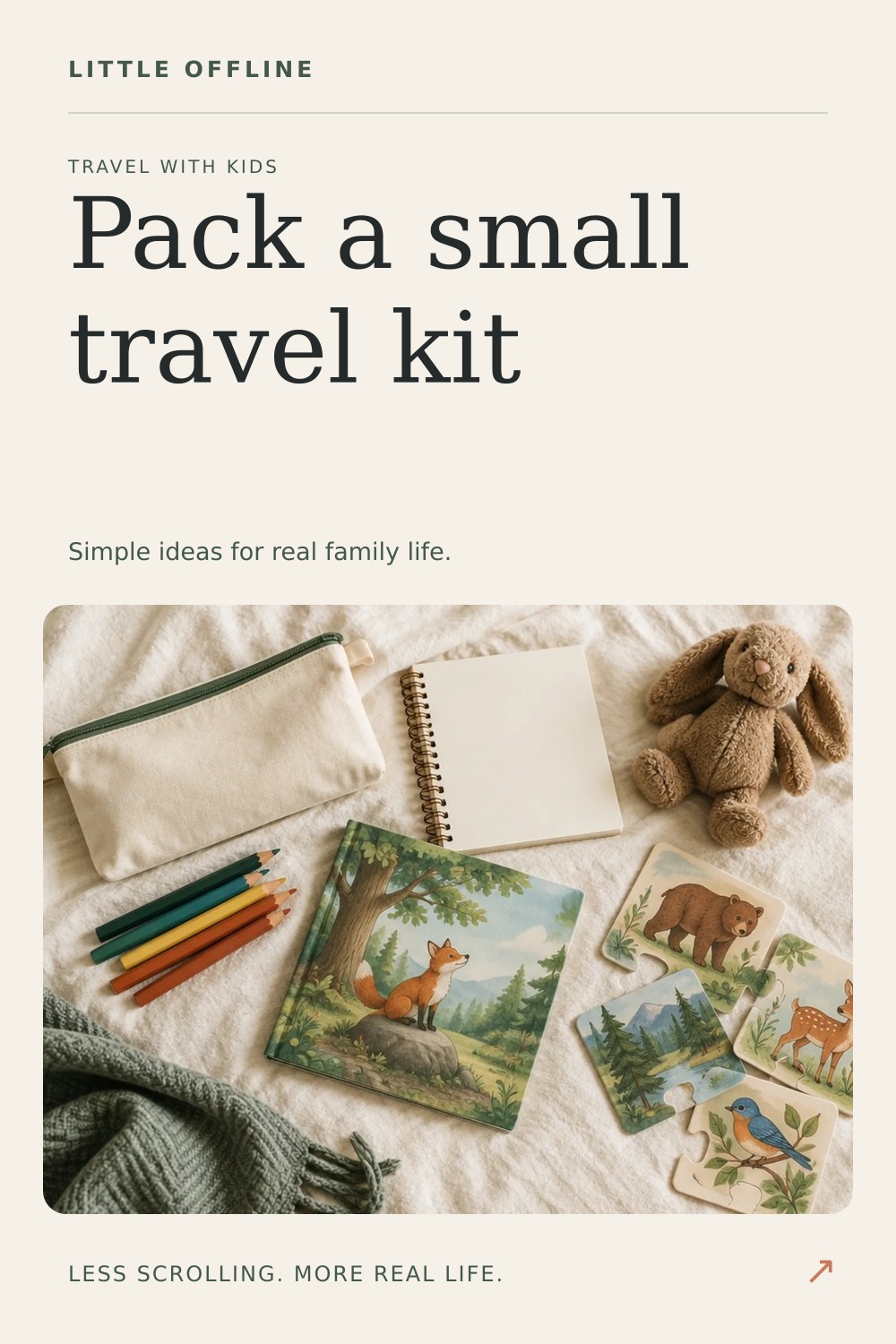
Start with a book the child knows, a notebook and a drawing tool suitable for their age and setting. Add a familiar reusable activity only if it is easy to contain. Keep a short spoken-game list on a card so an adult does not need to search online in the moment.
A child can help choose within this structure. Ask them to show how each item works and where it goes afterward. If the demonstration creates a pile of pieces or requires a long explanation, that is useful information before the trip.
Add age support, not arbitrary age quotas
A younger child may need an adult to peel a sticker or begin a story. A six-year-old may enjoy drawing but need help with written prompts. An older child may prefer choosing a book and notebook independently. Plan around these actual needs rather than packing a certain number of items per year of age.
Keep materials appropriate for everyone who can reach them. A kit for an older sibling may include parts that are unsuitable for a younger child nearby. Separate storage and adult oversight matter more than the label on the outside of the bag.
Pack and rehearse checklist
Keep a refresh rule that saves effort
After an outing, replace used paper, clean items according to instructions and remove things nobody wanted. Keep the familiar favorites. One new drawing prompt can refresh a notebook without replacing the whole kit.
If the bag is not helping, diagnose the mismatch. The activity may be too difficult, the setting too cramped or the child in need of rest rather than entertainment. Buying more supplies is not automatically the next step.
Useful for these ideas
Gather a few things. Then start.
We may earn a commission through shopping links, at no extra cost to you. These are editorial suggestions, not claims of hands-on product testing. Details.
Travel & waiting
Reusable sticker scenes
A quiet option for story scenes at a table, restaurant or destination.
Check before you buy
Check the dimensions, age label and small parts. Some pads are too large for a small bag.
Travel & waiting
A zippered activity pouch
Keeps the small kit from the busy-bag guides together.
Check before you buy
Measure the notebook first. Choose a simple closure and avoid long loose cords.
Questions parents ask
Do I need separate kits for every setting?
Usually not. Keep a small base kit and swap the one item that does not fit the setting.
What is the most useful item to buy first?
Check what you already own. A compact notebook and suitable drawing materials are versatile, but the best first item is one your child already enjoys and can use.
Save a little inspiration
Keep this idea for later.
Save the guide to your family activities board.
Save to Pinterest

