
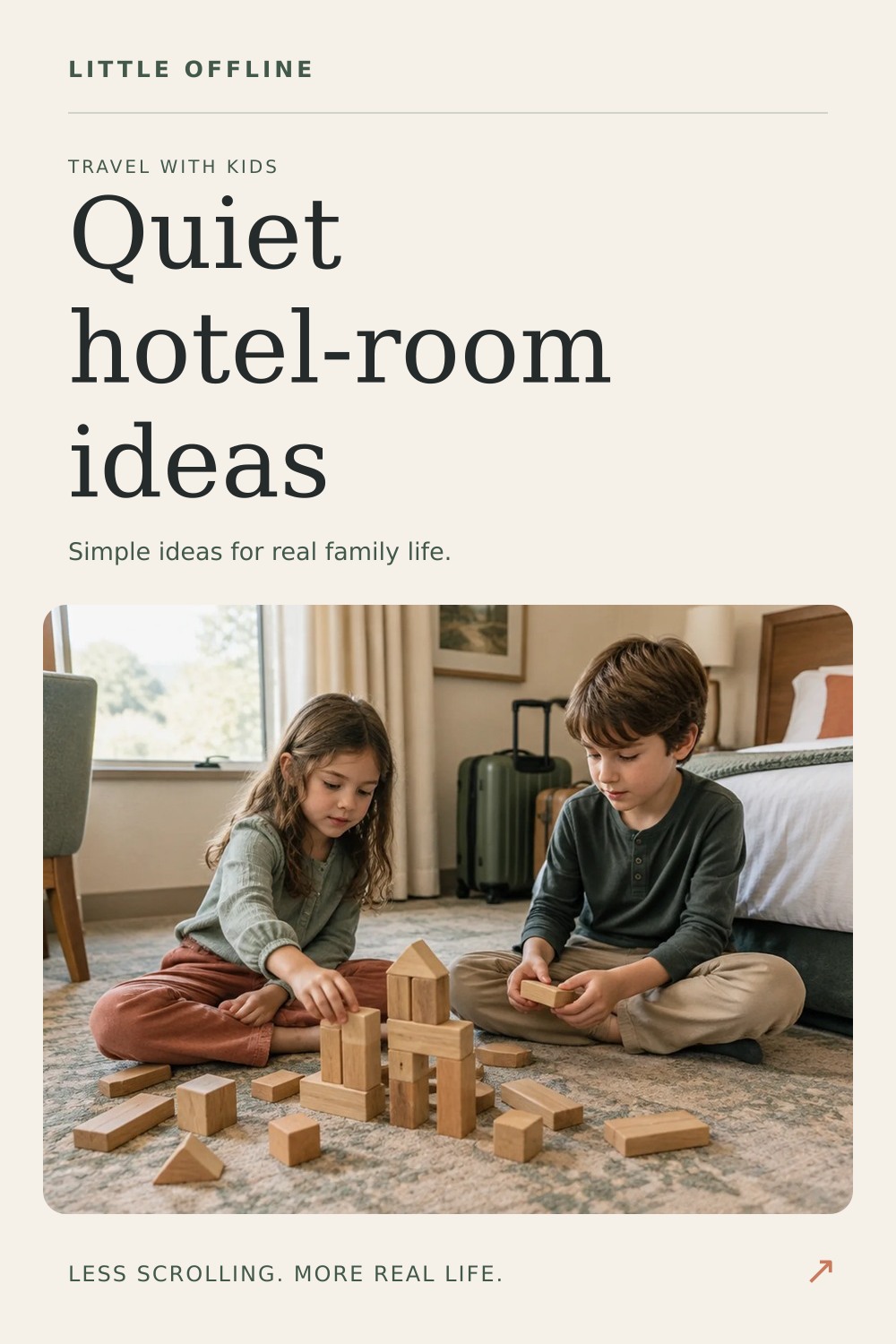
A hotel room can be a welcome pause or a difficult holding space between plans. Children may be excited by the unfamiliar setting while adults need to unpack and regroup. A few quiet options help without requiring another outing or a large travel kit.
Begin with the practical room check and the family’s immediate needs. Adults handle windows, balcony access, cords, furniture stability and other hazards. Activities come after the space and supervision are appropriate, not instead of them.
Create one small activity area
Use a suitable desk or table surface for your own paper and supplies. Protect it from marks and keep materials away from drinks, toiletries and electrical items. A small pouch makes it easier to check that everything is collected before checkout.
Avoid taping to walls, moving heavy furniture or using towels and bedding to build unstable structures. A pretend hotel can exist on paper; the real room does not need to be transformed.
10 activities to choose from
Time and age labels are planning suggestions. Use the adaptations and provide the adult help your child needs.
1. Draw the missing half
What you need: Paper and crayons. Cost: Use what you have.
Fold a sheet in half and draw one side of an imaginary creature, a house or a leaf. Unfold it and invite your child to finish the other side. Matching is optional: a tiny wing beside a huge wing can become the beginning of a story. Swap roles after the first picture so the child gets to set the challenge.
Make it fit: Younger kids can add marks anywhere. Older kids can try symmetry or deliberately invent an asymmetrical creature.
Adult help: Adult nearby.
2. Book picture expedition
What you need: A picture book you already own. Cost: Use what you have.
Open a familiar book and ignore the printed story for one round. Look for something tiny, someone who might be surprised and a place you would like to visit. Give your child time to explain what they see instead of turning it into a right-answer quiz. On the next page, let them choose the question.
Make it fit: Nonreaders can point. Confident readers can find a sentence that supports their interpretation.
Adult help: Adult nearby.

3. The scribble rescue
What you need: Paper and crayons. Cost: Use what you have.
Make a loose scribble and pass the page to your child. Ask what the scribble could become when you add a few lines: a sleepy cat, a storm or a ridiculous vehicle. There is no best transformation. Add one detail at a time, or take separate pages if sharing a single picture leads to arguments. End by giving the creation a title.
Make it fit: Younger kids can choose what you add. Older kids can turn the same scribble into two different ideas.
Adult help: Adult nearby.
4. Make a comic in four boxes
What you need: Paper and pencil. Cost: Use what you have.
Fold paper into four panels. In the first, introduce a character who wants something; in the second, add a problem; in the third, try a solution; in the fourth, show what happens. Stick figures and speech bubbles are enough. If writing slows the fun, take dictation for your child while they draw the action.
Make it fit: Younger kids can narrate one panel. Older kids can make a wordless comic another person can understand.
Adult help: Adult nearby.
5. Design a pet for a planet
What you need: Paper and crayons. Cost: Use what you have.
Invent a planet with one unusual feature, such as permanent rain or very tall trees. Draw an animal that could feel at home there. Ask where it sleeps, what it carries and how it greets a friend. There is no need to make the design scientifically correct; make the imagined needs and choices clear enough for someone else to follow.
Make it fit: Younger kids can choose one feature. Older kids can label adaptations and sketch a habitat.
Adult help: Adult nearby.

6. Three clues, one object
What you need: Nothing beyond the room around you. Cost: Use what you have.
Secretly choose an object everyone can see. Give three clues about its use, shape or location without pointing to it. Let your child guess after each clue, then trade roles. Choose objects well within reach of sight and skip anything that encourages climbing. If the game becomes too hard, add a generous final clue rather than protecting your secret.
Make it fit: Use familiar objects for younger kids. Older kids can avoid mentioning color or the first letter.
Adult help: Adult nearby.
7. Make a kindness postcard
What you need: Paper and crayons. Cost: Use what you have.
Fold or cut a sheet to postcard size with adult help where needed. Draw something the recipient would enjoy and add one specific kind message, such as thanking them for reading a story. Your child may dictate the words. Deliver it within the household or save it for a real adult-managed mailing; no addresses need to be shared online.
Make it fit: Younger kids can make marks and choose the recipient. Older kids can address an envelope with help.
Adult help: Adult nearby.

8. The one-page treasure map
What you need: Paper and pencil. Cost: Use what you have.
Draw a pretend island with three landmarks and a starting point. Give a character a route using directions such as past the tree and around the pond. Let your child choose what the treasure is and why someone hid it. Playing entirely on paper works when the room is small or you do not want a real hunt to scatter belongings.
Make it fit: Younger kids can follow a finger path. Older kids can add a key, compass directions and decoy routes.
Adult help: Adult nearby.
9. The hotel memory sketch
What you need: Notebook and crayons. Cost: Use what you have.
After settling into a hotel room, draw one detail that feels different from home, such as a reading chair or a view. Keep room numbers, security details and other guests out of the drawing if sharing it later. Use the desk or a safe flat surface and protect hotel furniture from marks.
Make it fit: Younger kids can choose a color. Older kids can write a short arrival note.
Adult help: Adult passenger helps; driver stays focused.
10. The story-in-an-envelope kit
What you need: An envelope with a few large drawings. Cost: Use what you have.
Draw a character, place and ordinary object on separate large paper cards. Pull one of each and make a brief story that uses all three. Return the cards to the envelope between rounds so nothing gets scattered. A child can draw new cards at the destination and reuse the same kit on the return trip.
Make it fit: Younger kids can choose two cards. Older kids can add a problem card.
Adult help: Adult passenger helps; driver stays focused.
Match the activity to the travel-day mood
After a long journey, a familiar book or simple drawing may be better than a new game. Before another outing, choose something with a short clear ending. During a longer indoor break, an older child may enjoy a comic or journal while a younger child shares a picture book with an adult.
Keep noise considerate of neighboring rooms and use gentle seated or tabletop activities. If children need more movement, find an appropriate supervised space outside the room when conditions allow rather than using beds or furniture as equipment.
Make checkout easier from the beginning
Keep activity supplies in one designated place and put one item away before opening another. Count comfort items and reusable supplies before leaving. Check drawers and under safe accessible furniture areas with an adult.
A final journal prompt can be one thing that felt different from home. Keep room numbers and security details out of any shared page. Then pack the notebook and let the room return to being a room.
Useful for these ideas
Gather a few things. Then start.
We may earn a commission through shopping links, at no extra cost to you. These are editorial suggestions, not claims of hands-on product testing. Details.
Travel & waiting
A small blank notebook
One notebook can hold a travel journal, a homemade maze and a story game.
Check before you buy
Choose blank or lightly lined pages and a size that fits your pouch.
Questions parents ask
Can we make a blanket fort in a hotel?
Choose a safer floor-level reading spot using your own appropriate materials and normal supervision. Avoid moving furniture, blocking exits or creating unstable structures.
What should we pack specifically for hotel downtime?
Usually the same compact travel pouch: a book, notebook, suitable drawing supplies and one familiar quiet activity.
Save a little inspiration
Keep this idea for later.
Save the guide to your family activities board.
Save to Pinterest

